
Building the WOTAM feasibility toolkit
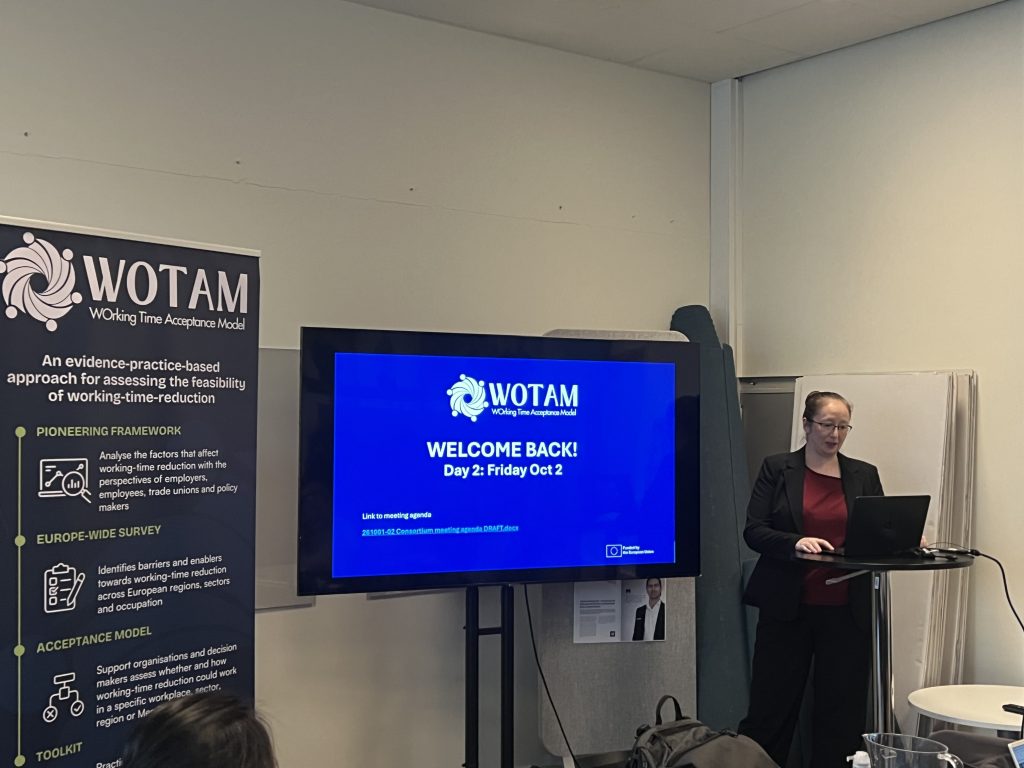
This October, Sarah Rose Flynn, Senior Consultant at BluSpecs led an interactive workshop focused on developing one of WOTAM’s most important project outputs: the Acceptance and Feasibility Model and the practical toolkit that will eventually support stakeholders interested in Working Time Reduction (WTR).
The workshop centred on two of WOTAM’s biggest deliverables, the Acceptance and Feasibility Model and the toolkit that will sit on top of it. Both are meant to help employers, unions, researchers and policymakers figure out whether Working Time Reduction could work for them, not whether it should.
What are we actually trying to measure?
The Model needs to capture the big-picture, labour law, policy, social norms, alongside the on-the-ground reality: staffing levels, how work is actually organised, what technology is available, how the organisation is structured. The group spent time on trust, fairness, whether people feel they have a voice, the culture of the place. Sarah Rose and the team mapped these against four types of feasibility, operational, economic, institutional and social.
The toolkit won’t say WTR is good or bad will do is help an organisation work out whether, where and how it might work for them, in their sector, their region, their reality. WOTAM’s job is to build the evidence and the tools; the decision stays with the people.
What stakeholders need
A key part of the workshop involved breakout discussions where partners reflected on the needs of future toolkit users. Several themes emerged:
- Organisations need practical ways to access readiness, risk and feasibility before introducing WTR.
- Stakeholders require tools that support dialogue, negotiation and decision making.
- Case studies, success stories and real-world evidence will be essential for building trust and credibility.
- Productivity, service quality, workforce planning and long-term impacts must be considered alongside employee wellbeing.
Participants also generated ideas for future toolkit features, including readiness assessments, stakeholder mapping templates, cost modelling tools, case study libraries, pilot design resources and monitoring frameworks.
A consortium wide effort
The workshop concluded with a discussion on how each work package can contribute to the Acceptance and Feasibility Model and toolkit, reinforcing that their development will be a genuinely consortium wide effort.
By bringing together different perspectives at an early stage, the session laid important foundations for creating practical, evidence-based resources that can support informed conversations about the future of Working Time Reduction across Europe.
Want to see where this goes? Follow WOTAM on LinkedIn and check the project website for updates as the Model and toolkit take shape.