
New European project WOTAM launches to help Europe make better decisions on working time
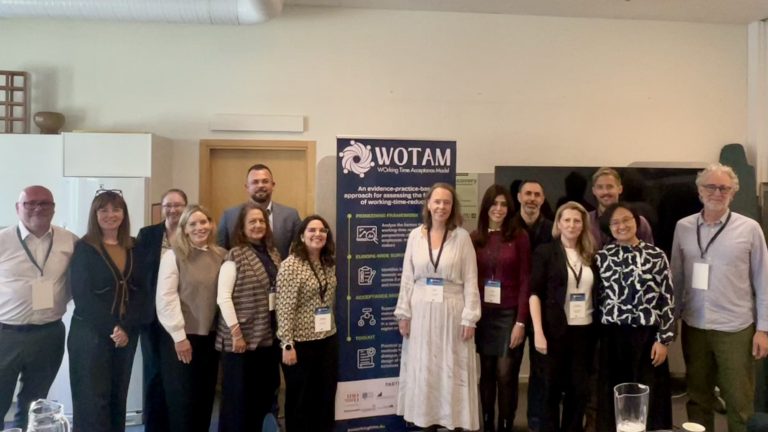
Västerås, 1 October 2026 – Shorter working weeks. Reduced hours. Four-day pilots. Across Europe, governments, employers and workers are testing new ways to organise working time, with claims made on all sides about the effects on wellbeing, productivity and sustainability. What is often missing from the debate is a clear, evidence-based understanding of when, where and under what conditions Working Time Reduction (WTR) is actually feasible.
WOTAM, a new European research project has launched, and the official kick-off took place the 1 of October hosted by Mälardalen University, the project coordinator. WOTAM does not advocate for or against WTR. Instead, it is an empirical research initiative designed to build a rigorous evidence base and practical assessment tools that support informed dialogue and decision-making, whatever conclusion stakeholders reach in their own context.
A more complex way to study working time
WOTAM brings together researchers and stakeholders from across Europe to examine how WTR policies and practices are developed, implemented and experienced in real workplaces.
The project’s starting point is that decisions about working time are shaped by more than measurable outcomes. Productivity data, cost calculations and health indicators matter, but so do the beliefs, values and positions of employers, unions, employees and policy makers. WOTAM will study both dimensions together, offering a more complete and neutral basis for understanding the topic than research that considers material factors in isolation.
The partners
WOTAM is delivered by a consortium of 12 partners from Sweden, Ireland, Spain and Poland, combining academic research with direct links to the labour market.
The team includes Mälardalen University (Sweden, project coordinator), Trinity College Dublin (Ireland), the Economic and Social Research Institute (Ireland), the University of Seville (Spain) and the SGH Warsaw School of Economics (Poland), BluSpecs (Spain), the Irish Congress of Trade Unions, Kommunal – the Swedish Municipal Workers’ Union, DigitalES, the Polish HR Association, Almega employers’ organisation (Sweden) and the Irish Business and Employers Confederation. Bringing together expertise in economics, sociology, organisation studies and ethnography ensures that WOTAM’s research reflects the perspectives of trade unions, employers and professional bodies across different sectors and regions, rather than a single viewpoint on WTR.
Expected outcomes
Over 36 months, WOTAM will produce:
- Two conceptual frameworks mapping the societal and organisational factors associated with WTR, combining empirical evidence with stakeholder perspectives.
- A validated, EU-wide WTR Survey, gathering comparable data on barriers, enablers and conditions for feasibility across regions, sectors and occupations.
- The WOTAM Model, an analytical tool for assessing the feasibility of WTR in a specific organisation, sector, region or Member State.
- The WOTAM Toolkit, a practical resource with guidance, templates and methods to support structured assessment and dialogue on WTR.
- A Community of Practice and knowledge Hub
Impact
By generating comparable, EU-wide evidence, WOTAM aims to move the conversation on working time away from anecdote and assumption and towards a shared, empirical basis for discussion.
The project’s frameworks and model are designed to give stakeholders with different, sometimes opposing, views a common analytical reference point, supporting more constructive dialogue between trade unions, employers and policy makers without prescribing a particular outcome.
In the longer term, WOTAM’s evidence and tools are intended to inform discussions on labour market policy, workplace organisation and working conditions across Europe, providing organisations and decisionmakers with a rigorous basis for their own assessments of WTR.
—
About WOTAM
WOTAM is a European research project funded under Horizon Europe dedicated to understanding the barriers, challenges and impacts of Working Time Reduction (WTR). Through interdisciplinary research, stakeholder engagement and evidence-based analysis, the project seeks to develop new conceptual frameworks, practical tools and policy recommendations that support informed decision-making on the future of working time in Europe.
See more here https://euworkingtime.eu/